


When most people hear “wealth transfer,” they picture passing assets to the next generation, trusts, inheritances, and legacies handed down over time. But there is another kind of wealth transfer, one that happens not between generations but across state lines. Increasingly, affluent families are moving their wealth in search of lower taxes, stronger asset protection, and a more favorable financial home. The move may be prompted by retirement, a career change, or a life event, but executing it well depends on careful planning. Families are often so focused on the move itself that they miss the financial and legal ripple effects that can follow a change in domicile. For those with substantial wealth, relocation involves far more than choosing a new home. It requires thoughtfully unwinding connections to a former state, connections that can carry significant tax, estate planning, and financial consequences long after the moving trucks have departed.
At Truxton, we are privileged to help families navigate these transitions with purpose. While the decision to move is often driven by personal circumstances, it should also be viewed as a strategic financial decision. Creating a new tax home is only part of the process. Just as important is thoughtfully severing the connections that may continue to bind a family to its former state.
Domicile, Residency, and the Financial Stakes
Changing your tax situs, where you are legally and financially considered to reside, can have significant implications for high-net-worth families. States such as Tennessee, Florida, Texas, Arizona, and the Carolinas continue to attract affluent households seeking lower tax burdens and business-friendly policies. These states were among the largest beneficiaries of wealth migration in 2023.[1] But wealth rarely leaves without resistance.
States that lose high-income taxpayers increasingly scrutinize residency changes through sophisticated audit programs designed to preserve their tax base. New York and California, which impose some of the highest marginal income tax rates in the country, stand to lose substantial tax revenue when wealthy families relocate. New York’s Nonresident Audit Guidelines and California’s Residency and Sourcing Technical Manual differ in their technical standards, yet both circle the same question: Has the taxpayer genuinely relocated their life, or have they simply acquired a new address? In New York, taxpayers bear the burden of proving a change of domicile through “clear and convincing evidence.”[2] California applies a similarly rigorous facts-and-circumstances analysis, weighing whether a taxpayer has established stronger connections to the new state than to California.[3] A driver’s license or voter registration may help, but neither is dispositive. Auditors look beyond paperwork to the taxpayer’s overall pattern of living.
Domicile Is More Than an Address
Because auditors focus on where a taxpayer maintains their closest connections, the relevant facts are personal: where family members reside, where children attend school, where physicians and advisors are located, where business interests sit, and where a taxpayer maintains social, religious, and community involvement. Taxing authorities may even consider the location of safe deposit boxes, valuable personal property, and charitable activities. New York distills this into five primary factors: the home, active business involvement, time, items “near and dear,” and family connections. Together, these frameworks reveal an important reality: residency audits are designed to expose inconsistencies. If a taxpayer claims to have moved but keeps the majority of their personal, business, and social relationships in the former state, taxing authorities may conclude the move was incomplete.
The Hidden Trap: Statutory Residency
Even after successfully changing domicile, some taxpayers remain vulnerable to the separate challenge of “statutory residency.” Under New York’s rules, an individual may still be treated as a resident if he or she maintains a permanent place of abode in the state and spends more than 183 days there during the year. Partial days count toward that total. A quick business meeting, an evening event, or a short visit can unexpectedly add up. This catches many families off guard. They assume a Florida driver’s license or a new voter registration ends the inquiry, when in reality a furnished apartment or second home in a former state may continue to create tax exposure long after the move itself.
The “Leave and Land” Principle
The clearest lesson from both New York and California is that establishing residency requires two separate actions: landing in the new state and leaving the old one. Successfully leaving is just as important as successfully arriving. Many taxpayers focus almost exclusively on the first step, purchasing a residence, obtaining a license, registering to vote, and spending more time in their destination state. Those actions matter, but auditors are incentivized to spend equal or greater effort examining the ties left behind. Retaining a prior residence, maintaining significant business involvement, leaving family members behind, or continuing to spend substantial time in the former state can undermine an otherwise well-planned relocation. For high-net-worth families, the most successful moves are those that deliberately plan for both establishing new connections and unwinding old ones.
Compensation, Trusts, and Estate Planning Complications
The tax implications of relocation can follow individuals far beyond moving day. Stock options, restricted stock, and other equity compensation structures are often sourced to the state where the services were performed between grant and vesting dates. A former state may continue taxing a portion of the income even after a taxpayer relocates. Deferred compensation can present similar issues, as certain payout structures qualify for favorable treatment while others let the state where the income was earned keep asserting taxing authority.
Trusts and estate plans add another layer of complexity, because trust taxation, fiduciary responsibilities, and asset protection laws vary substantially among states. An irrevocable trust anchored in a high-tax jurisdiction may generate consequences long after a grantor or beneficiary has moved. Reviewing trust situs, trustee selection, governing law provisions, and fiduciary relationships should therefore be an integral part of any relocation strategy, along with wills, powers of attorney, and healthcare directives, to ensure they are compliant with the laws of the new state.
Building a Defensible Change of Domicile
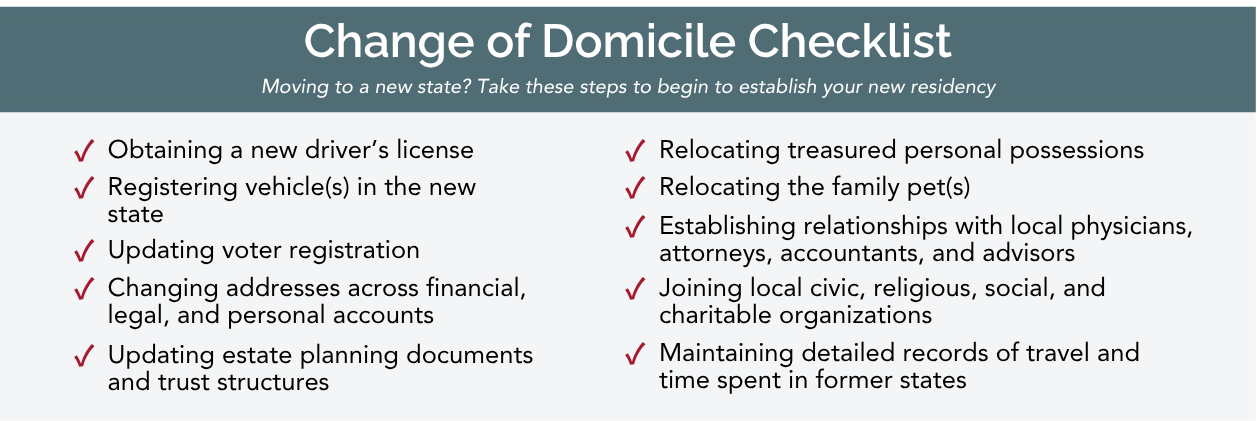
For families contemplating a move, consistency is everything. Every action should reinforce the same narrative: that the new state is now the family’s permanent home. Below is a practical checklist for those who want to start the process for changing their domicile:
The Importance of Professional Guidance
Relocation can create meaningful opportunities for tax savings, estate planning flexibility, and long-term wealth preservation, but the benefits are only realized when the transition is properly documented and supported by consistent actions. The lesson from New York’s audit guidelines and California’s residency manual is the same: changing residency is not a matter of checking administrative boxes. It is a matter of demonstrating, through objective evidence, where your life is centered.
Moving to a new state may take a weekend. Establishing a defensible change of residency can take months, or even years, of deliberate planning and documentation. At Truxton, we support families in more than 27 states and regularly help clients navigate the financial, tax, and estate planning implications of relocation. If you’re considering a move or simply want to confirm that a prior move accomplished its intended objectives, we would welcome the opportunity to help. ▪
[1] Visual Capitalist, U.S. States Gaining and Losing the Most Wealth (2024), citing Internal Revenue Service migration data, available at Visual Capitalist.
[2] N.Y. State Dep't of Taxation & Fin., Nonresident Audit Guidelines (Dec. 2021).
[3] Cal. Franchise Tax Bd., Residency and Sourcing Technical Manual (Jan. 2026 rev.).


