

There’s a new tax break for charitable giving that is unique, generous to taxpayers, and you’ve probably never heard of it.
A Little-Known Credit With Broad Implications
The Federal Scholarship Tax Credit was part of the One Big Beautiful Bill Act passed in 2025. The credit begins in tax year 2027 and, while a subsequent Congress could kill the program, there is no “sunset” in the statutory language.
Under the law, gifts of up to $1,700 per year to “Scholarship Granting Organizations” (SGO) can reduce your Federal Income Taxes dollar for dollar as a direct credit. This is not a deduction, it is a credit, so it costs the taxpayer nothing once your taxes are filed and paid. States have to “opt-in” to the program. So far 29 have done so, including Tennessee.
The SGO then grants financial aid to students in private elementary and secondary schools, presumably beginning with the Fall 2027 school year.
Recipients of the scholarships must have a family income less than 3x the Area Median Income (AMI) but that should include all but very affluent families. The potential to grow scholarship dollars under the program is huge.
Scaling the Opportunity for Schools and Donors
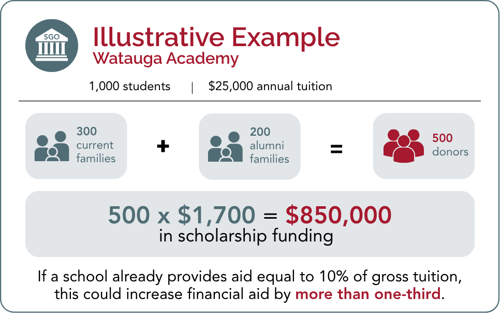
Consider a fictitious private school, Watauga Academy with 1000 students in grades K-12 and a tuition of $25,000 per year. The school could educate parents about the program, directing them to an SGO with which the school has a relationship. Parents, at no net cost (after the tax credit), could give $1,700 per year to the SGO. If 300 families of current students and 200 loyal alumni families give to the SGO, the result would be $850 thousand of scholarship money for students at Watauga. If the school is already providing tuition assistance equal to 10% of gross tuition, the new tax credit could increase financial aid by more than one third.
Again, the program allows the taxpayers to redirect money they would pay anyway – and redirect it to scholarships at a school they care about. Why not do this? A school with a large, loyal alumni base including thousands of families with more than $1,700 per year in federal income tax liability could raise millions of dollars at no net cost to the donors. It really should simply be a matter of educating your constituency and making the giving simple.
Preparing Ahead of 2027
The program begins in 2027, which will be here very soon. The Nashville area has no SGOs today so the local private school community should mobilize to create one or more of them soon. Anyone with a relationship with a local private school should make certain they are prepared to affiliate with an SGO and are prepared to educate their affiliated families about this exceptional opportunity.
The detailed rules around this tax credit have not been published. There is still time for the local philanthropic community to maximize this opportunity. But action is needed. We spoke recently to Amy Popadick of the Children’s Scholarship Fund, a New York based SGO. She confirmed that Tennessee is currently largely unserved by scholarship grantors, the organizations which must receive the money subject to the tax credit. Putting together an effective SGO for Nashville will take much work and organization. The SGO will have to be able to adjudicate scholarships at scale, receiving application from thousands of hopeful recipients. We are optimistic that local private schools can benefit significantly from this opportunity, but that will require action – and soon. ▪